

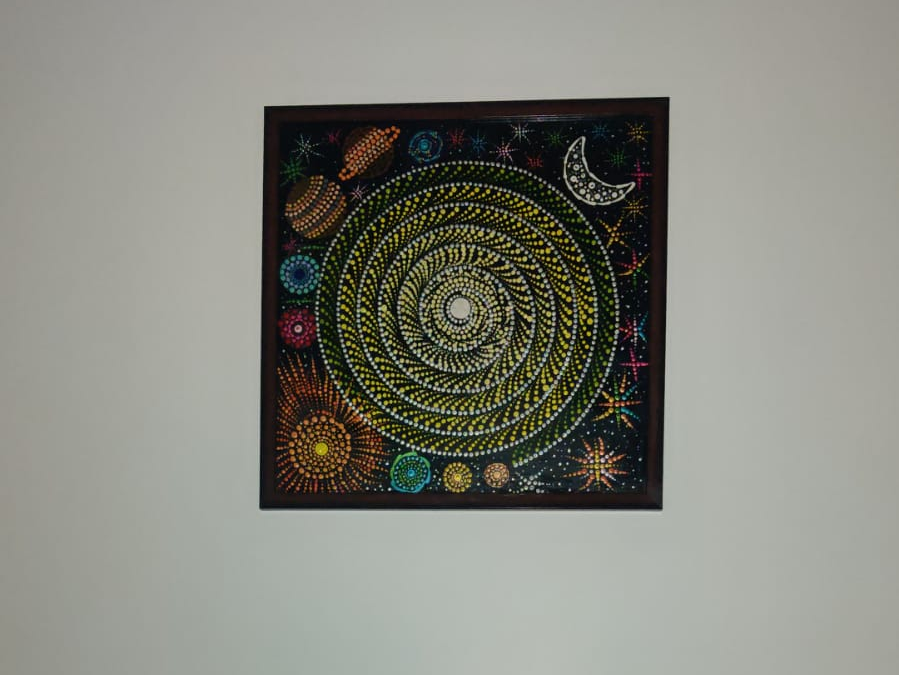
I have often said art is one the best gifts that one can give to a sustainable friend or family member. Art shapes culture, and creation of art is especially a sustainable act as it allows us to exercise our creativity and encourages introspection. When I moved into a new home, one of the things I wanted to do was cover it with art that reflects my tastes, values, and maybe even showcases different cultures. While my walls await their decor, one of the first pieces I installed was a mandala painting sent as PR or barter collaboration by DVK Creations and Designs. It has a soothing texture, not too much or too little which my texture living would want more of but that’s just me, and vibrant colours without being too bright. The painting shines, even in the dark of dusk without any bioluminescent materials. Alongside it I also received a bookmark of mandala art, which I absolutely adore. One notable thing about the painting is that my guests could remember it from my housewarming, despite us being focused on other things, which J feel is a testament to the skill showed by the artist, especially in the creation of the planets as one can easily decipher which planet is meant to be which despite them not being in order due to the details such as the rings around Saturn and the size of Jupiter. Despite being crowded the piece isn’t overwhelming and while it might not seem to add much value to my life at first glance, when looked at with intention, it makes me smile, reminding me that it does add value (or I hope it does). My guests even realised it was meant to show the solar system without that being mentioned, which might not be a great feat (I would not know) but feels worth mentioning. Here’s what a fellow artist who saw the piece had to say-
The dotted artwork pulls the viewer in by not just the spiral galaxy in the middle, but by the fineness of the piece. At first glance it might look simple, but once your eyes begin to linger the viewer can see the details of the solar system.
Another artist said the following-
I love how the painting has a particular theme it follows. A bit of Galaxy/night light theme going on. Personally I enjoy how each and every color compliments each other and despite being detailed, the eye isn’t overwhelmed.
It’s really soothing to look at, and despite the whole canvas being filled, it doesn’t overcrowd. It is a beautiful work.
I don’t know whether they lingered on the piece or not, but if it was a brief glance, I would feel it’s the skill of the artist that stayed with the viewer. Of course, if possible creating our own art is the best way to go but sometimes we might be like me and doubting our skill or wanting to support other professional artists or simply not have the time to make something before a gift or lack of the skills to convey a particular idea or want different styles around, all of which leads us to an artist to either learn from, create with, or support without turning it into overconsumption, though if it adds value can it be that when done intentionally?
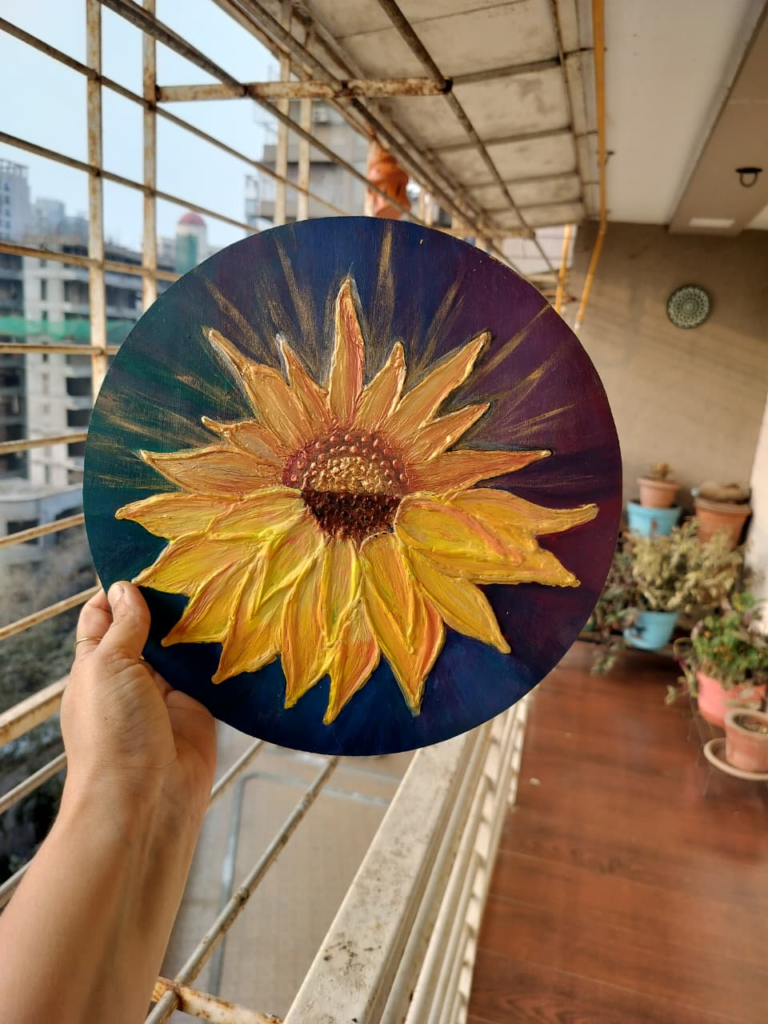
Now, I’m not an art expert and hence can’t myself comment on the technique or the artistry of the piece beyond what I’ve shared from my guests and artists who saw it. As a layman, I find it soothing and beautiful to look at, however, and the message that it’s meant to symbolize positivity and the sun are important to me, especially as the sun is a source of renewable energy as well as what one of the planetary bodies whose existence sustainable photosynthesis and thus life itself.
What I wanted to review was the sustainability of the brand and the piece, because when we support art and artists, we can also encourage green practices in the craft. After all, most paints today are acrylic based which rely on petroleum and the fossil fuel industry. While there are undeniable benefits to the same, do they contribute to us inhaling microplastics? Such questions help us move the craft in a healthier direction for both the artist and the collectors. Yet, it is important to preface the discussion with the knowledge that while non acrylic paints exist, and non petroleum based acrylics also exist, the latter aren’t commonplace for many, and different mediums as well as paints lead to different forms of art. Hence, we see painters painting with coffee, discarded makeup, and more. Personally, I love the idea of upcycling expired products into art, but that’s just me. But let’s dive into DVK Creations and Designs’ art and their process to see how sustainable they’re.
DVK Designs and Creations Art: Sustainable?
The piece that I got sent was made using acrylics which were non-toxic from popular brands like Fevicryl and Flash. The painter tries her best to ensure the paints get used to the last drop, never disposing of anything, and even preferring paint bottles over tubes to reduce waste! Moreover, she creates her own paints which are stored in recyclable glass bottles.
Yet, she has to dispose of the paint on the brush after soaking them overnight, as putting them in plants might kill said plants despite the non-toxic claim, making me question whether the painter is getting greenwashed, and prompting a deeper dive in the brands they’ve said they use. Fevicryl, Flash, Granotone, and Camel. Other than paints, our artist also uses clay, which remains a very sustainable material, and resin, which being mostly plastic based, has the same microplastic issue as acrylic despite its durability.
Deep dive into the paints used
- Fevicryl
The paints used for this particular painting comes from the Fevicryl brand, which claims to be water-based and non-toxic. While not biodegradable, they’re marketed as safe and low VOC, and as the artist said using such paints removed the need for a glass cover for the painting since these dry and don’t tarnish easily. Another perk is they’re easily available and can even work on porous substances since they’re waterproof. While they’re said to be certified safe, no names of the issuing committee can be found easily.
- Camel
A household name, Camel is a 100% vegan brand that claims to be non-toxic and water based. Again, it can be used in a variety of materials and like all acrylic paint dries water-resistant.
–Flash
Made in India, these paints too don’t require frequent reapplication. Suitable for a multitude of surfaces, these paints are marketed as non-toxic and being of premium quality including being water-resistant and having strong brush stroke retention. Yet no details of third-party certifications are shared by Lakshmi Paints, the brand behind the name.
–Granontone
Another Indian brand, Granotone marketed itself as non-toxic, odourless, and low VOC paint that can be applied on multiple surfaces. The brand says they’ve pledged to help create a sustainable future, and have used an eco-friendly formulation without sharing much details on how they’ve done the same for their non-cracking acrylics.
While the most sustainable are fair-trade certified and eco-friendly certified paints, using what you’ve is always better before making a swap.
For DVK Creations and Designs we can see that while not 100% sustainable due to their ties with the fossil fuel industry, they are using accessible options for acrylic paints that claim to be less damaging to the planet and produce long lasting art.
And paint isn’t the only thing that makes a painting. The artist has shared that she goes to local vendors for framing, an effort we love. They also use Woodle India base or once again get custom MDF cutouts from local vendors to reduce waste, an effort we appreciate. While many claim MDF is sustainable due to its use of recycled materials and its action as a carbon sink, some traditional formulations used toxic to health binding resins and were difficult to recycle, but that last bit is probably not a concern with art. However, we can’t say that these art pieces are sustainable without ensuring they’ve used eco-friendly and more important, health friendly binders and low-emission MDF boards, unless they’re upcycling.
But materials aren’t the only thing that sees whether a product is sustainable or not. Other than durability, packaging is an important consideration, as well as value. The artist has shared that the art is therapeutic to them and they make vaastu themed paintings, which can add value to those who believe in vastushastra, or simply those interested in cultural and artsy decor like me. It’s a great conversation starter!
Financial Affordability
Plus the pieces have a wide range of pricing options available starting from ₹800 and going up to ₹30,000. Moreover, supporting women’s business and financial independence is often an ecofeminist choice, but of course, not always.
So now let us take a look at how this pairing was packed when it was shipped to me.
Packaging
Mostly it came packed in cardboard which being compostable and eco-friendly we love, even if we know that single use paper is actually more resource intensive to produce when compared to microplastic causing plastic. The tape used was plastic tape, yes, but it came off easily, and the painting was bubble wrapped. While we understand that the cushioning was important to ensure the piece wasn’t damaged, we wonder if honeycomb paper couldn’t be used instead, and yet we applaud that only reused bubble wrap was used as using what you’ve is always more sustainable than a new eco-friendly swap. In that vein, we have kept the bubble wrap to be used during monsoons to ship books without damage. Just like this artist does with even foam, even if creation and disposing of that is a sustainable nightmare and a half.
Conclusion: Our Suggestions and Green Highlights
Art is always a sustainable gift, especially when we create it ourselves or connect with the artist. The artists behind DVK Creations and Designs was kind enough to send me a note explaining the painting and the dot mandala style they’ve used, which requires patience. They also do pichwai art, and lippian art which is a traditional art form and the artist supports local vendors, making their brand a move in the right direction. On their individual level by reusing paints, opting for bottles over plastic tubes, and making and store their own paints they’re engaging in sustainable acts. The paints they use aren’t particularly sustainable in my opinion nor have these paints claimed to be fair trade despite their eco-friendly claims, which could either be a sustainable move on the artist’s part or a place where they’re greenwashed. We also acknowledge that accessibility to eco-friendly paints (unless one makes them themselves) might be an issue and strongly encourage the artist to see what green options they can switch to which are certified, or explore natural paints used in traditional forms and how they lasted. We adore the use of reused materials in their packaging and understand that wooden frames can only be provided to clients with a higher budget and hope the company finds affordable and durable alternatives to the acrylic frame used in the PR piece.
Yet, when you have to reuse packaging to keep it affordable, can we be choosy? The question here then becomes how to make sustainable art accessible and how to help people who can afford a higher price tag understand the importance of greener materials being used so that mindful brands like DKV Creations and Designs can truly explore sustainable art beyond individual choices.
Overall, we call this brand a step in the right direction with a way to go. Kudos.
Find the artist’s catalogue here.
Author’s Note: Thanks for reading, hope this added value to your life.
Top rated products
-

A Bard’s Tale: On, Love, Longing, And Other Things
₹199.00 -

Maa
₹199.00 -

Once and Thereafter
₹199.00 -

Realisations in Quarantine
₹199.00 -

Siya: A Su*cide’s Argument
₹199.00